
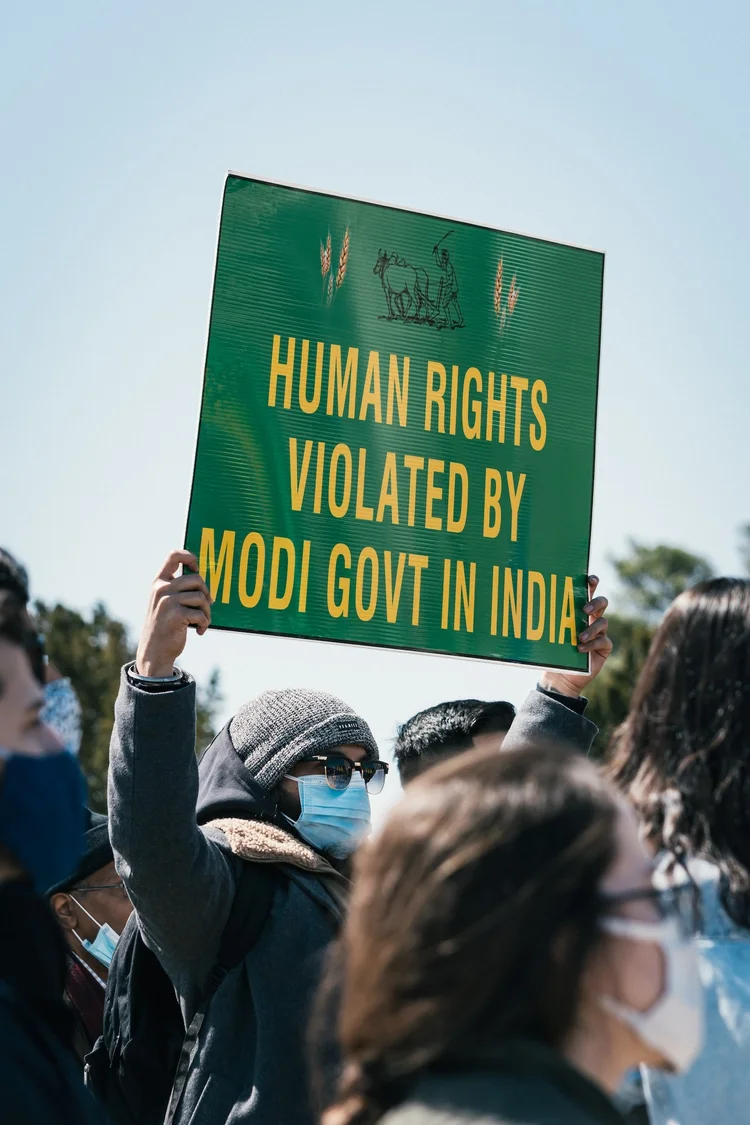
In its most recent attempts at stifling dissent, the Indian government banned a two-part BBC documentary, “The Modi Question,” launched mid-January.
It is being viewed privately in homes and at special screenings in academic institutes in India and abroad to recall a 20-year-old collective poignant memory.
The documentary is a painful yet necessary recollection of the allegations against the Indian prime minister, Narendra Modi, as it reveals very little new information except finding Modi was “directly responsible” for the “climate of impunity” that enabled the violence in the anti-Muslim riots in the northwestern state of Gujarat in 2002.
A thousand people, predominantly Muslim, were killed. Modi, then Gujarat’s chief minister, was widely condemned for not directing the state authorities to stop the violence against the Muslims. Many foreign governments also took note and disengaged with him, and the U.S. government revoked his visa then.
Earlier this month, the documentary was screened at Columbia University’s Journalism School and Harvard University’s Graduate School of Design, among others. At Columbia University, the screening was followed by a panel discussion led by progressive academics, Indian activists and journalists.
Panelist Audrey Truschke, a historian of South Asia and an associate professor at Rutgers University, explained the symbolism behind banning this documentary.
“The fear that the BJP has of this documentary being seen abroad is that it drives home the point that this isn’t over. It’s not closed, and it’s not going away,” Truschke said. “And none of that can happen until we address the causes of the 2002 Gujarat pogrom. And so long as Modi, the BJP, and Hindu nationalism are in power in India, we can’t move beyond because you have to move through and confront the problems because otherwise, it will happen again. Maybe in a different part of India, the violence unfolds slightly differently, like in the Delhi riots in 2020. But that’s what we all fear: There’s going to be another chapter in the story.”
Of the 162 countries assessed, India ranks eighth as an at-risk country to inflict mass violence in 2022 or 2023, according to the Early Warning Project, a joint initiative of the United States Holocaust Memorial Museum and Dartmouth College. In its 2022-23 statistical risk assessment report published in November, it noted:
In 2022, the Hindu nationalist-led government’s systematic discrimination against the Muslim minority has continued to intensify amid mounting reports of violence met with impunity to restrict Muslim rights. Hindu nationalist leaders have continued to propagate hate speech, including religious leaders’ calls for mass killings of Muslims in December 2021. Several states saw large-scale and violent incidents targeting Muslims in recent months, which involved Hindu nationalist processions engaging in derogatory anti-Muslim chants and the desecration of mosques. In response to these violent provocations, local authorities bulldozed Muslim-owned property across several states, which rights groups cited as an apparent attempt at collective punishment.
Safa Ahmed, a media associate, at Indian American Muslim Council, an organization formed in the aftermath of the Gujarat riots in 2002, pointed out that while the documentary is a “gateway” to learning about the events that transpired during the riots, it fails to address the deeper issues and lacks testimonies from victims.
“I was waiting for a woman’s voice because it was the Muslim women of Gujarat (who were most brutalized),” she said. “Pregnant women were slit open, women were gang-raped by the masses and were burnt alive, and older women were stripped and burnt alive. Children were force-fed petrol and burnt alive. I hoped the documentary would’ve revealed these stories as they have gone untold for over two decades.”